MECHANICAL INTELLIGENCE AND CREATIVE INTELLIGENCE
AI has solved an important open problem in mathematics.

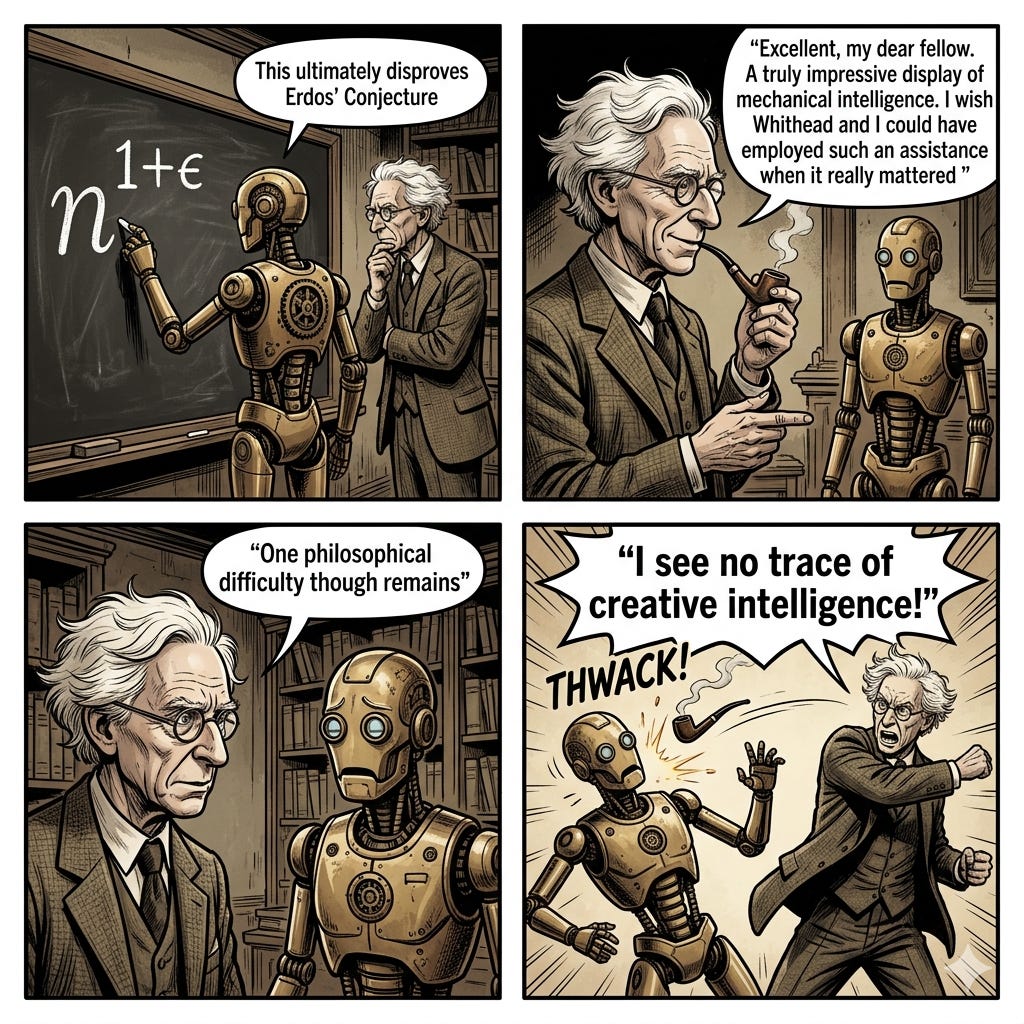
At last it happened: an unreleased language model from OpenAI solved a major, longstanding open problem in mathematics. In 1946, Paul Erdős asked, quite simply, the following geometrical question: If you draw n points on a sheet of paper, how many pairs of points can be at distance 1?
This deceptively simple question turned out to be incredibly difficult. Erdős himself conjectured that, as n grows to infinity, the number of such pairs approaches n. Because of its simplicity and elegance, the problem has since attracted the attention of countless mathematicians working in combinatorial geometry. It was one of Erdős’ favorite problems. The standard collection Research Problems in Discrete Geometry describes it as
possibly the best known and simplest to explain problem in combinatorial geometry.
Most mathematicians were persuaded that Erdős was right and struggled to confirm his conjecture. Yet, against expectation, OpenAI’s model has proven that the number of pairs at distance 1 grows as a polynomial
Commentators, so far, have been divided: the skeptic’s classical “yes, but…” has been invariably accompanied by the AI bro’s “superintelligence has landed and will kill us all”.
As I argued in my recent essay on intelligence, this confusion stems from the lack of a framework for interpreting and judging AI performance. Intelligence, I argued, is largely determined by these two factors:
the ability of efficiently acquiring existing concepts: mechanical intelligence;
the ability of inventing new concepts: creative intelligence.
These represent different yet complementary capacities. One thing is to notice an existing pattern or invariance in the world; it is another to create a structure that previously did not exist.
On one hand, the world — the universe — is structured. Planets orbit stars; plants transform solar energy through elaborate biochemical processes; animal bodies possess systems of organs performing intricate functions. To navigate a fiercely competitive environment, living beings need to learn the rules that govern its dynamics. These rules are already there: one needs to figure them out — and adapt. This is a mechanical intelligence, as its task is to identify existing organization. It is a very mathematical kind of intelligence, one that learns correlations and structures that emerge in the world.
On the other hand, the human mind exhibits extraordinary creativity. Just look around: all of the technology, art, social rules surrounding us is pure invention. Sometimes inspired by nature, sometimes not. This is the creative intelligence, the kind of intelligence that appears, at present, unique to humans.
In this essay, we shall interpret the progress of AI in light of this distinction. We shall examine the declarations of the experts and see how they support a thesis I have advanced for some time here on Substack: it is not surprising that AI continues to improve in science, as it is a valuable form of mechanical intelligence that can potentially reach very far. Yet, it remains, for now, less creative and adaptable than the human mind.
MECHANICAL INTELLIGENCE IN ACTION
How did AI solve the Erdős conjecture?
Most of the experts converged on one point: the solution is clever and technically impressive. According to Jacob Tsimmernman:
This is a really impressive piece of work, and I would accept it for any journal without hesitation. I actually briefly worked on this problem and tried to make a counterexample, but failed to make progress.
Arul Shankar observed:
I had not encountered this problem before seeing the proof from OpenAI, and I found the proof to be a clean execution of a very beautiful idea and quite well written up. (…) In my opinion this paper demonstrates that current AI models go beyond just helpers to human mathematicians – they are capable of having original ingenious ideas, and then carrying them out to fruition.
Nogal Alon likewise noted:
The solution of the problem by the internal model of Open AI is, in my opinion, an outstanding achievement, settling a long-standing open problem. The fact that the correct answer is not $n^1+o(n)$ (Erdos’ Conjecture) is surprising, and the construction and its analysis apply fairly sophisticated tools from algebraic number theory in an elegant and clever way. As explained by the remarks of some of my colleagues here there are several reasons that explain why AI tools can be better than humans in finding such a construction. With or without a full agreement with these reasons, the fact is that the AI was able to do here what lots of excellent human researchers tried and failed to do.
But Thomas Bloom expressed a degree of disappointment:
If the result of this paper was a proof of the unit distance problem, that would be truly incredible. While I was still very surprised to hear of the this result, this was dampened slightly when I learnt it was a construction of a counterexample, and still further when I learnt that nature of the construction, being (with the benefit of hindsight) a natural, albeit highly non-trivial, generalization of the original lattice-based construction of Erdős.
This last point is important: AI did not create fundamentally new concepts; rather, it combined existing techniques with impressive sophistication. In mathematics, to generalize a technique means employing it in a broader or more complicated setting, where previous results offer no guarantee of success. AI found a generalization of Erdős’ original idea that worked in a considerably more difficult setting. It involved methods from algebraic geometry and number theory, and required mastery of highly sophisticated results such as the Gold-Shaferevich construction of infinite class field towers. Nobody expected these techniques to work.
How did AI arrive at its solution? Shankar points out that
The CoT showed the model trying out a vast array of ideas from a wide range of mathematics for the required construction. The model went through ideas pretty quickly, but when it reached the crucial idea (in the paragraph starting with “Suppose optimistically that…”), it honed in on the proof quite methodically.
In other terms, AI behaved here as a mechanical intelligence. By combining brute force with an unrivaled breadth of knowledge, it explored a vast range of technical possibilities. Then it insisted — stubbornly — until the selected technique worked. Many human mathematicians would have lacked such fierce determination, fearful of wasting their time on a highly technical argument, without intuition that it ought to succeed. Humans, unlike AI, have lives. They must constantly balance risk against opportunity.
Melanie Matchett Wood argues:
I believe if the level and type of human expertise that is represented on this note had been assembled to find a counterexample to this conjecture a month ago, and those people put in similar amounts of time working on it than they did to reading and thinking about Chat GPT’s solution, the mathematicians would have found a counterexample. However, without the claimed proof by Chat GPT, there is no particular reason anyone would have tried to look for a counterexample, assembled a group of experts with the appropriate expertise, or that the experts would have agreed to turn their attention to this problem.
Humans might therefore have found the AI solution; they simply had little reason to look for it. To be fair, challenging prevailing assumptions and succeeding is a sign of intelligence.
For instance, finding a counterexample was exactly what the 17 years old, homeschooled mathematical prodigy Hannah Cairo recently did. She startled the academic world by disproving the 40-year-old Mizohata-Takeuchi conjecture in harmonic analysis. Using an unexpected fractal construction, she proved that certain wave-based functions do not always behave as mathematicians had predicted.
Cairo’s solution, however, was conceptually innovative, and her methods were subsequently applied in many other contexts.
UNDERSTANDING VERSUS PROBLEM-SOLVING
This leads us to a crucial point. Although popular discourse often reduces mathematics to mere problem-solving, the discipline is oriented toward conceptual comprehension and analysis.
Mathematicians are not so much interested in knowing whether a statement is true as in understanding the deep reasons it holds.
When we study undergraduate mathematics we are taught theories and tools that allow us to solve a wide variety of problems. The aim of higher mathematical education is not to teach solutions to particular celebrated problems, but to cultivate a conceptual framework for mathematical thought.
As Daniel Litt observed:
Many of us work on programs, rather than problems
Indeed, a completely ad-hoc solution of a problem is not so appealing as a set of concepts that reveal deep truths about mathematics itself.
For example, from Leibniz onward, philosophers and mathematicians were obsessed with figuring out a mathematical account of human logical thinking. This pursuit was not a mathematical statement with a definite truth value waiting to be determined, like “what is the value of x if x + 3 = 2x”? To search for a mathematical treatment of logic is a desire — a research program. It reflects human aspirations to understand deeply the world and ourselves. But what constitutes a full solution is not even clear. This research program was carried out successfully by Leibniz, Boole, Frege, Peano, Russell, Tarski and many others brilliant thinkers over the course of centuries. It is not the sort of thing for which one simply pushes a button and receives an answer.
CREATIVE INTELLIGENCE
The desire to autonomously create is alien to mechanical intelligence, for its task is to merely achieve an objective. Creative intelligence aims first to understand and only afterward to create, often without any immediate objective. It is liberty of thought and freedom of invention.
Some people may object that creativity does not actually exist in any strong sense: humans themselves would only combine existing concepts. This, as I already anticipated, is mistaken. Logic here may help to gain further understanding of creativity.
A logical argument is said to be analytic if the ideas involved are already contained in its assumptions or conclusions. In other words, it occurs frequently that a mathematical problem can be solved without resorting to out-of-the-blue ideas, but combining the concepts at play in a clever way. For instance, many problems in elementary number theory can be solved without resorting to methods from other areas of mathematics.
I believe that current AI’s reasoning is analytic, though in a broader sense of the term. If we replace the concept of equality with similarity, we can define analytic reasoning as:
a sequence of thoughts containing ideas similar to those already present in the reasoning assumptions and conclusions, or in established techniques from the literature.
The novelty here lies in employing the notion of similarity. This concept is admittedly vague, yet AI itself makes it mathematically precise. One may ask an AI whether one mathematical concept resembles another and obtain a perfectly rational answer. This happens because large language models represents concepts in a geometrical space where similarity becomes a kind of distance. When Shankar tells us that
the CoT showed the model trying out a vast array of ideas from a wide range of mathematics for the required construction. The model went through ideas pretty quickly (…)
we can see analytic thought in action, exploring techniques that previously succeeded in sufficiently similar contexts.
By contrast, humans sometimes solve problems by means of completely new ideas that embody an unprecedented way of thinking. One can prove that within most mathematical theories, some questions can only be answered with creative, non-analytic reasoning.
CONCLUSION
The question is no longer whether AI can think, but what kind of thinking it can achieve. I have long predicted that AI would emerge as extraordinarily skilled assistant capable of solving problems with analytic thinking. It is now happening. This will transform our research as mathematicians. It will ultimately transform all scientific areas.
Yet, this is by no means a human-level intelligence and the technology now available is unlikely to produce one. Deep understanding, extraordinary creativity and theory development do not appear within reach of current AI architectures. The catastrophic failure on ARC-AGI 3 demonstrates that some issues remain unsolved. The progress is real and remarkable, though, and the distinction between mechanical and creative intelligence that we have offered helps explain how such an advancement was possible in the first place.
I believe at this stage one should be extremely cautious about company demos. The proof/counterexample was obtained by an undisclosed custom internal model that seems to have been specifically tailored/fine tuned to the problem by two future fields medalist caliber mathematicians Mark Sellke and Mehtaab Sawhney with the help of another CS prodigy Lijie Chen. They probably iteratively fine tuned the scaffolding, model, context/RAG and verifier and biased it towards promising strategies (all of which can then conveniently be hidden behind the undisclosed internal model) and then OpenAI claimed an autonomous result when the model after having a 125 page random walk (and that’s just a summary) was able to tumble over the finishing line under the watchful eyes of expert mathematicians who then picked up the output, checked it and turned it into an actual proof.
The fact that nowadays a group of brilliant mathematicians tweaking an AI into producing a proof is considered a much bigger breakthrough than them proving the thing themselves should in itself be enough to show how proficient these systems actually are at mathematics.
Well done, this is a fairly balanced take on the OpenAI result unlike the techno-hype surrounding it or the complete cynical dismissal of it seen in what I refer to as the “professional AI skeptic” community.
The technology is still flawed and there is significant room for improvement, but I am not sure we can conclude from that a priori that “mechanical intelligence” will remain inferior to “creative intelligence” or that only humans are capable of creative insights. Furthermore, many pronouncements about human exceptionalism should be met with as much as skepticism as the hype surrounding AI.
You said: “But deep understanding, creativity and theory development do not appear within reach of AI models.” I’d love to pick your brain on the following:
Is this a specific claim about the current paradigm of LLM-based AI models, or a more general claim about any possible AI architecture, and if it is the latter, what theoretical or physical barriers fundamentally preclude artificial systems from achieving these traits?
Is this a testable empirical hypothesis, or is it a non-falsifiable philosophical position, and if it is testable, what specific, measurable benchmarks or behavioral outputs would constitute sufficient evidence to convince you otherwise? Would progress on ARC AGI 3 make a difference?
Where exactly is the line between “complex pattern matching” and “deep understanding”, and is there a quantifiable mechanism that differentiates the two, or do you view understanding as a moving goalpost that shifts whenever AI masters a new cognitive domain?
What you are calling creative intelligence arose through evolution and the collective interaction of humans over time. Many in the AI skeptic community tend to believe that human intelligence is an essential, individualized “secret sauce” construct of a brain when, in reality, human intelligence is a product not only of a brain but also of interaction between humans and environmental conditions. For example, studies of feral children show that human intelligence is greatly curtailed and there are certain gaps that cannot be filled in with later training after this form of deprivation occurs. I don’t think anyone has offered a definitive proof for the inherent superiority of this “natural” process or has shown that it is the only way that creative intelligence could arise in the universe even if you may be correct about the deficiencies of the current AI paradigm.