WHAT IS CREATIVITY? CAN AI CREATIVITY BE TRAINED?
An analysis of the implications of the revolutionary news concerning mathematics

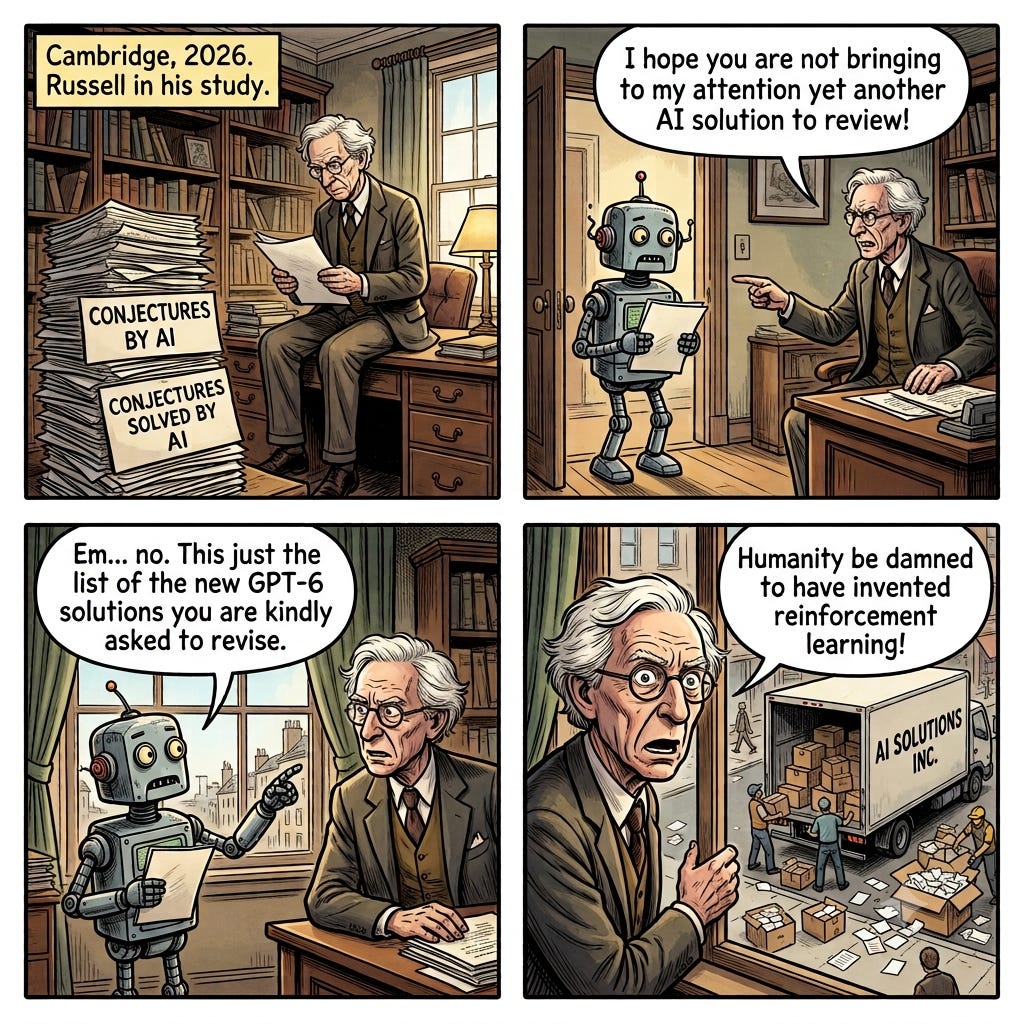
A hurricane is sweeping through the immutable and perfect Platonic forms of the mathematical world. Over the past few weeks, three longstanding mathematical conjectures have fallen, yielding in a few hours to OpenAI’s and Anthropic’s frontier language models: GPT 5.6 Sol and Fable 5. Two conjectures were refuted, one fully proved.
Like a summer storm, this hurricane arose unpredictable and violent. Will it soon pass, or is it rather a foretaste of the far greater AI storm, long announced, but yet to come? Does this news challenge our understanding of what creativity is and how it is achieved? These are the difficult questions I shall try to answer in this essay.
THE SOLVED CONJECTURES
The three famous conjectures are:
The Erdős Unit Distance Conjecture. In 1946, Paul Erdős asked, quite simply, the following geometric question: Given n points in the plane, how many pairs of points, among all possible choices, can be at distance 1?
The Cycle double cover conjecture is a famous problem in graph theory, first formulated in 1973. It states that every bridgeless graph has a list of cycles such that every edge is in exactly two of them. The problem inspired a vast literature and attracted considerable interest.
The Jacobian conjecture. In 1939, the German mathematician Ott-Heinrich Keller posed a question: if the Jacobian determinant of a polynomial mapping is a nonzero constant, does the mapping necessarily have a polynomial inverse? Here we need not discuss the technicalities. It suffices to say that the problem was so hard that it led to error even Ytan Zhang, the mathematician who first proved the existence of infinite pairs of prime numbers separated by a bounded distance.
First, in the face of the astonishing resolution of these conjectures, I feel forced to adjust, if not my beliefs, at least my terminology. To be sure, these recent mathematical results, albeit stunning, do not challenge my distinction between mechanical intelligence, possessed by both humans and AI, and creative intelligence, currently possessed only by humans. If the recent developments do anything, they confirm this distinction. As I defined the terms, mechanical intelligence is tasked with problems to solve and solves them using analytic reasoning, which I define as:
a sequence of thoughts whose conceptual ingredients are already contained in the premises, in the desired conclusion, or in established techniques from the literature.
On the other hand, creative intelligence discovers, creates, synthesizes new conceptual frameworks, providing us with both questions and tools to answer them.
All three conjectures have been resolved without offering any general insight or any technique that we did not know before.
In the case of the Erdős Unit Distance Conjecture, the model constructed an unexpected counterexample by linking discrete geometry with algebraic number theory — a connection that was however known by earlier mathematicians.
In the case of the Jacobian conjecture, the disproof is a one-line counterexample, probably found through extensive calculation — we do not even know.
In the case of the Cycle Double Cover Conjecture, GPT-5.6 Sol Ultra deployed 64 parallel subagents pursuing different approaches, ultimately reducing a 50-year-old graph theory problem down to linear algebra over a finite field.
Nevertheless, in view of these recent developments, calling the first kind of intelligence “mechanical” may now feel dismissive. Solving problems that have been open for decades does require a degree of originality. Even when the methods are already known, they must be adapted and combined in a novel way that no one has envisaged before. Many mathematicians possess these skills, and have thereby cultivated successful careers. Since my intention was never to belittle this form of intelligence, I propose to call the two intelligences: analytic and synthetic. In brief, analytic intelligence solves problems by analyzing and modifying known concepts; synthetic intelligence operates by synthesizing new concepts that are general and worthwhile in their own right.
Analytic intelligence is now abundant in frontier AI models, in some cases even surpassing its human counterpart, as these mathematical achievements suggest. GPT 5.6 Sol and Fable 5 are so extraordinary that we have run out of ways to test their mathematical abilities. All benchmarks, even the private ones like Frontier Math and Riemann Bench, have been saturated. Framing AI as a statistical machine does not do it justice: AI now possesses analytic intelligence. But what about synthetic intelligence?
CONCEPT CREATION
Creativity implies the creation of new concepts. As simple as it sounds, this capability of the human mind puzzled philosophers since ancient Greek. Plato famously asked how it is possible to arrive at the idea of circle or equilateral triangle, given that neither perfect circles nor perfect equilateral triangles can be found anywhere in the world. Not only can we never draw them perfectly: it is dubious whether perfect geometric figures can exist in nature at all. How, then, can we create the idea of circle?
This is the riddle of creativity: it often appears to come out of nowhere. Plato attempted to solve this enigma by postulating that sensory experience only triggers recollections of perfect and timeless ideas, acquired during a past life and encoded in our soul. Perhaps, to avoid circularity, one must assume that the soul has always possessed such ideas — but you get the point.
Aristotle called the Platonic forms universals and argued they are acquired, starting from empirical observation, through the mental process of induction. Yet Aristotle never investigated its nature, and did nothing to prove that induction is different from recollection.
ARTISTIC CREATIVITY
Artistic creativity is at one time simpler and harder to understand than scientific creativity. It is simpler, for artistic invention arises from within our mind, and thus represents a free act of creation; scientific discoveries, on the other hand, come also from without, as they have roots in a complex, external reality. For this reason, however, artistic creation is also harder, since the invention is not guided by anything outside us.
Artistic creativity, however, is valuable precisely because it is not random. Homer’s Odyssey is profoundly imaginative, but it is also based on the archetypal concept of the hero’s journey, one of the fundamental patterns of human narrative. For this reason the Odyssey is so effective in moving our human sensibility as opposed, for example, to modern adaptations. A recent example is Nolan’s movie, which departs from the very principles on which the Odissey is based, losing the hero’s arch and recasting it around beliefs alien to Homer’s story.
One of my favorite examples of creativity in music is Vivaldi’s Four Seasons. Whenever someone claims that human artists are not really creative, that they only recombine or reshuffle previous ideas, I tell them the following story. Vivaldi’s music had been completely lost after his death in 1741, hidden in some forgotten library. They were rediscovered by chance two hundred years later.
Vivaldi’s music was so innovative that it still sounds modern today, as shown by the dozens of Instagram and Youtube influencers that are still playing Vivaldi’s Summer or Winter. One of its innovations was to treat the first violin player as a virtuoso soloist, with the goal of entertaining as well as impressing the audience with masterful riffs, much like the guitarists that came 250 years later in rock and metal music. That was bold and innovative, and quietly influenced Western music ever since. Moreover, the cleverness and beauty with which Vivaldi portrayed the seasons is unmatched, and if his music had disappeared forever, it would have been a dramatic loss for humanity. Unlike science or mathematics, creative art cannot be “rediscovered”.
In my personal experience of both mathematical and musical creativity, I find that the latter feels much more mysterious and elusive. My first classical music album (The Reason of Beauty) feels to me much more personal and original than any mathematics I have done. In math, I have the feeling of discovery; in art, of creation ex nihilo. And yet, I believe that the underlying process is fundamentally the same in mathematics and music.
SCIENTIFIC CREATIVITY
Several famous scientists and mathematicians, including Russell, Poincaré, Hadamard, Einstein, and Wiles, have attempted to explain the psychology of scientific creativity. A recurring picture is the dark room analogy.
You enter a completely dark room. You spend months stumbling around, bumping into furniture, gradually getting a feel for where everything is located. At some point you encounter what seems to be a statue. You begin to examine it by touch. One part appears to be a leg. Is it a human? Not quite. It is too large. You feel a fang. Still, you remain in the dark. At last, you feel the presence of enormous ears. At that point a sudden moment of illumination, as a flash of insight, breaks into consciousness: it is an elephant and you are in a museum!
Since the final resolution comes suddenly, after long exploration and little progress, one can mistake it for inexplicable inspiration. Yet it is the hard and frustrating work of feeling your way through darkness that fosters the arrival of the final inspiration. In a sense, even the bolder creativity must attach to something existing previously. Nothing is produced truly from nothing.
Poincaré thought that the unconscious mind continues to work in the background, generating and weighing countless ideas, colliding and merging with one another like particles. Out of millions of possible combinations, only a tiny fraction are meaningful or useful: the elephants.
During a famous excursion, after weeks of exhausting work trying to understand a class of functions, the Fuchsian functions, Poincaré took a break to join a geological field trip. As he stepped onto an omnibus, without any conscious thought of mathematics, the exact transformation needed to define the functions instantly came to him.
Building on Poincaré’s insights, French mathematician Jacques Hadamard published An Essay on the Psychology of Invention in the Mathematical Field. Hadamard synthesized introspective reports from leading scientists and mathematicians of his era and divided the creative process into four distinct phases:
Preparation: Conscious, rigorous work on the problem, gathering data and testing initial avenues until encountering some fundamental barrier.
Incubation: Setting the problem aside. The conscious mind turns to other tasks while the unconscious mind processes the information behind the scenes.
Illumination: A sudden, unexpected flash of insight where the solution enters conscious awareness.
Verification: Returning to deliberate conscious thought to rigorously prove, test, and write out the illuminated idea in formal language.
In my own experience, this account is largely accurate, although, unsurprisingly, I have never been aware of substantial work performed by my unconscious mind.
However, this still does not answer the main question.
CAN AI CREATIVITY BE TRAINED?
Although this psychological account of creativity helps demystify it, we know that there is no algorithmic recipe for creativity. Knowing that we must touch our way through a dark landscape and gather information is not especially informative. Einstein told us:
“The words or the language, as they are written or spoken, do not seem to play any role in my mechanism of thought. The psychical entities which seem to serve as elements in thought are certain signs and more or less clear images... conventional words or other signs have to be sought for laboriously only in a secondary stage.”
Indeed, Einstein’s famous thought experiments (Gedankenexperimente) — such as imagining riding alongside a beam of light or standing inside a falling elevator — are not easily replicable. Can you find your way to fully understand the mathematical laws of intelligence or devise efficient nuclear fusion just by thought experiments?
Perhaps the creativity of Einstein, Newton, Leibniz is an outlier. Although there are humans capable of exceptional leaps, inventing new conceptual frameworks is often a much more gradual process, unfolding over several generations of mathematicians bumping into walls, inventing awkward notation, making small tweaks, and slowly stripping away clutter until an elegant framework remains.
THE LINEAR ALGEBRA STORY
The history of linear algebra exemplifies the point. Few people pause to ask themselves how the concept of matrix multiplication was gradually discovered.
Yet linear algebra did not start as we know it today. It began as a practical, messy quest to solve systems of linear equations.
In the late 17th and 18th centuries, Leibniz and Cramer introduced coefficient arrays and Cramer’s Rule to compute solutions mechanically. These early methods treated coefficients as static grids of numbers, relying on tedious calculations with no geometric picture behind them.
That picture began to emerge when Laplace developed cofactor expansion, revealing that Leibniz’s and Cramer’s formulas were not just algebraic tricks, but a measure of signed volumes of high-dimensional parallelepipeds.
By the mid-19th century, the mindset shifted sharply. Eisenstein, Cayley, and Sylvester stopped looking at matrices as mere tables of numbers and started treating them as single mathematical entities. They coined the word “matrix” and formalized matrix multiplication, recognizing that applying one transformation after another is inherently non-commutative. A matrix became an object worth investigating in its own right.
The final abstraction leap was stripping away coordinate grids altogether to focus on the space itself. In 1844, Grassmann published a visionary, coordinate-free geometry introducing concepts such as linear independence, dimension, and orthogonal projections. Though ignored for decades because it was so far ahead of its time, his work was ultimately synthesized by Peano in 1888 into the clean, axiomatic definition of a vector space we use today.
In two centuries, the discipline transformed completely. Here we see a collective work of the mathematical community, endlessly producing new accounts and abstractions. There was no need for a single Einstein of linear algebra.
RECURSIVE SELF-IMPROVEMENT
But how can AI achieve the ability to create such conceptual frameworks?
The technique used to teach AI advanced problem solving is reinforcement learning. In a previous essay, I argued why it has proved so successful. The first language models were statistical parrots because of the way they were trained, not because of any intrinsic limitation of the Transformer architecture. Training them to solve problems enhances originality and reasoning.
Moreover, modern reinforcement relies on language models to evaluate their own chains of thought through the so-called LLM-as-judge approach. This is beginning to resemble recursive self-improvement. Traditionally, that expression referred to an AI model that can conduct its own machine learning research and thereby improve itself. But once a smart language model start judging each step of its own reasoning, improvement is no longer guided solely by a mechanical gradient. The model’s own intelligence participates in the learning process. In humans, intelligence shapes learning as much learning shapes intelligence. Something analogous may now beginning to happen in AI. Historically, the machine learning had this structure:
objective → gradient → updated weights
But modern reinforcement learning increasingly appears as:
objective → intelligent evaluation → gradient → updated weights
The optimization loop itself has acquired an intelligent component. The gradient is still doing the optimization, but what determines the optimization target is produced by intelligence rather than by hand-crafted reward functions.
The trouble is that the kind of intelligence that this technique stimulates is mostly the analytic, not the synthetic. When an AI is optimized to solve particular problems, every detour is negatively rewarded. Everything must be devoted to the single-minded objective of solving the problem.
Yet we have seen that in linear algebra, mathematicians spent years constructing abstract definitions, language, and axioms before those tools were ever applied to solve major problems. This holds for all sciences. Standard reinforcement learning evaluates actions based on their contribution to a narrow goal, like proving a theorem. If an AI spends 10,000 steps defining an entirely new mathematical ontology, standard reward signals will grade those steps as useless or neutral because no concrete part of the problem has yet been solved. To invent a paradigm, an AI cannot just optimize for immediate problem resolution.
When GPT-5.6 Sol Ultra solved the Cycle Double Cover Conjecture, it searched through combinations of existing machinery: a tactical search problem. Searching through the space of all possible formal systems, axiom sets, and foundational languages is a meta-search problem. The branching factor is enormous, practically infinite. Navigating that meta-space without getting lost in nonsensical abstraction requires a fundamentally higher level of conceptual pruning than standard Monte Carlo Tree Search can provide today.
At least so it appears.
There is, however, an important objection. Models running for weeks or months may bridge the gap to high-level creativity. If standard reinforcement learning brings models to the level of a sharp, professional human mathematician, as it seems to be happening, then giving those models the freedom to run long-horizon search over weeks or months may eventually lead them to creativity.
This is an important objection. Synthetic intelligence, even in humans, must be trained. Humans do not acquire their synthetic intelligence by training on great problems that require deep new insights to be solved. That would demand an impossible amount of time. Humans therefore train on increasingly difficult problems exactly as AI models do. Indeed, when students begin their Phd studies, often they find a large gap between the way they worked in the past and the way they must work for a PhD dissertation. But the longer time horizon will naturally lead them to surface a latent synthetic intelligence that the previous training must have been preparing. During their Phd they will have their first deep insights.
But humans possess something AI does not have yet: explicit memory. AI systems have limited context windows, which may not be suited for long-horizon work. They do not have an efficient way to inject new information into their neural networks. This could be a serious limitation.
TIME WILL TELL
I believe only empirical data will resolve the dispute. By the end of 2027 we will likely know. By then, AI models will routinely solve very difficult problems, likely faster than humans. If they continue solving problems without creating novel, important concepts, a fundamental limit will have been encountered. If not, human mathematicians will be, for the most part, obsolete. I am not sure what to hope for.
Another good essay, thanks for sharing. I appreciate your essay and think you made a lot of fair, reasonable points for someone in the skeptic camp. At the end you mention the invention of concepts, or not, by 2027 (why 2027?): if one’s definition of true intelligence requires generating a concept with absolute zero conceptual debt to the past, then by one’s own standard, human intelligence doesn't exist either. The myth of the isolated, lightning-bolt epiphany ignores how discovery actually works—it’s a lot like those 1980s classic action movies where a lone hero single-handedly obliterates an entire army, an entertaining fantasy of solitary genius that bears zero resemblance to real life. Even Grigori Perelman’s monumental proof of the Poincaré conjecture relied fundamentally on Richard Hamilton’s work with Ricci flow; he didn't invent the machinery out of thin air, he mastered and extended what was already built. I think your essay kinda hints at this point but it deserves reinforcement.
Also, given how vast the mathematical landscape is today, almost no human will ever invent something completely detached from what came before. Besides, who even gets to decide what counts as "fundamentally new"? Skeptics predisposed to downplay AI will simply move the goalposts forever, using subjective definitions of originality to dismiss any achievement. It sounds a lot like the classic overbearing father syndrome: no matter how much the successor achieves, the old guard will always find a way to reframe the triumph as frivolous, unearned, or missing some vague, arbitrary standard of "real" discipline. Many of these discussions about AI, we should all remember, are colored by human emotion and cognitive dissonance even if they are presented as being strictly factual or logically grounded.
At the end of the day, demanding total conceptual isolation isn't a benchmark for intelligence—it's just a rhetorical shield used to deny the very real, cumulative synthesis that both human and artificial minds rely on to push the boundaries of what we know.